
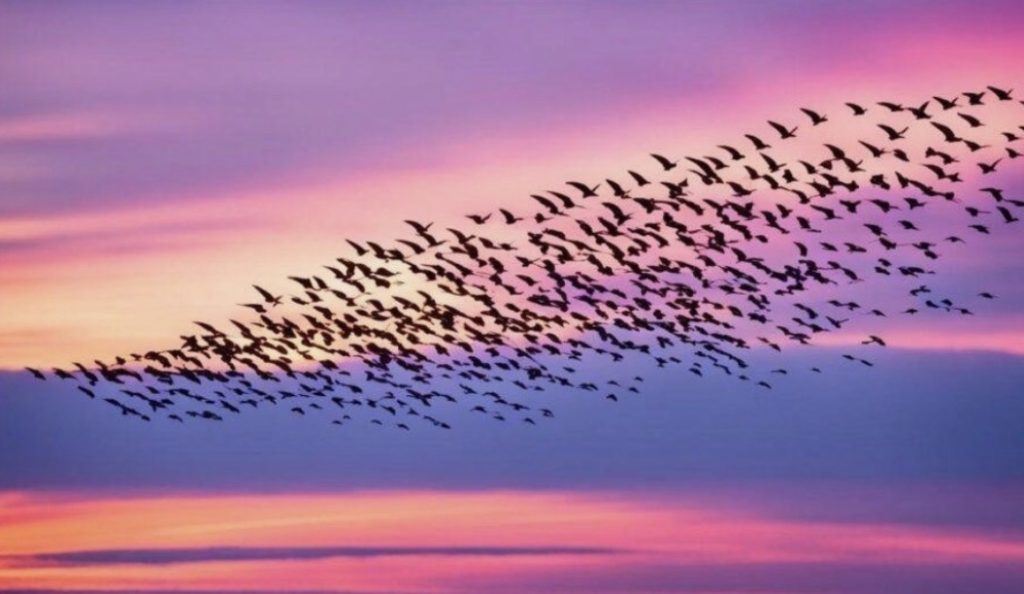
As we welcome Spring here on the island, we are seeing many new bird species begin to stop by on their way North. Hooded Warblers, Peregrine Falcons, and Terns have been spotted on and around Pigeon Key. But what exactly does migration entail for our feathered friends?
Where and Why
Many birds in North America are migratory, moving across continents to follow resources and favorable weather conditions. Species passing through the Florida Keys take the Atlantic Flyway, the extension of land down the East Coast from the Canadian Arctic to the Caribbean. That’s over 3,000 miles! A typical year for a migratory bird involves a lot of traveling. Winters are spent close to the equator where it is warm and food is plentiful. Spring means traveling North, often with multiple stops for rest and sustenance. Upon arrival in North America in the early Summer, adult birds will go about finding mates, breeding, and raising their babies. Then, in Fall, they start their long journey back South and the whole cycle starts again. Species of songbirds, raptors, shorebirds, and waterfowl all follow this routine throughout their lives. These are considered “neotropical migrants”, meaning they breed in North America, but Winter in Central America and the Caribbean.
The Long Haul
When the seasons begin to turn, photoreceptors in a bird’s brain will take notice of the changing length of daylight. This triggers hormones that cause the bird to begin growing flight feathers and eating voraciously. Migration is no easy task. Depending on the species, it can take anywhere from a few weeks to several months. This means they need lots of stored fat for energy and strong feathers to get through the long flight. During the journey, birds will also frequent stopover sights. Just like us humans take pit stops for food and rest during a long road trip, birds take breaks during their migration. Stopover sights are crucial habitats for birds to sleep, eat, and recover. Islands in the Florida Keys are popular stopover sights for birds traveling the Atlantic Flyway. Curry Hammock State Park, located on Little Crawl Key, hosts a “Hawkwatch” each year to count migrators that stop by for rest. In some years, over 30,000 raptors have been spotted in the park!
One of the most impressive migrators is the Arctic Tern. These birds have the longest migration path of any bird on the planet, literally going from pole to pole. They Summer in the North, from Washington State and New England up into the Arctic Circle. There they will breed and raise their babies. They then undergo a months-long migration South to Antarctica. Depending on their starting point, this can be a 44,000 to 59,000 mile round trip every year! They have evolved to be very efficient flyers but they are small in size, typically weighing 3 to 5 ounces!
How We Can Help
Unfortunately, some of our migratory bird species are in decline. One of the most dangerous threats is the loss of habitat to development and agriculture. Stopover sights are crucial locations for birds to rest and eat on their journey. Protecting our National Parks, nature preserves, and natural resources ensures these species will have space to recover during migration. Planting native species is another great way to help migrators by providing food such as insects, seeds, and fruits. Most flying during migration is done at night. Birds are often confused by electric lights, resulting in collisions with buildings that can be deadly. By dimming or turning off unnecessary lights at night time, we can ensure that they get to their destination safely.
Written By: Jennifer Gasser (Marine Science Education Intern)